


Abstract
Objective:This study aims to address the persistent challenge of students' vague understanding of the concept of liquid depth within the context of liquid pressure in junior secondary physics education. By designing a low-cost, intuitive, and scientifically effective self-made teaching aid, this research seeks to facilitate deeper conceptual learning and enhance students' practical inquiry abilities. The teaching aid not only serves as a visual demonstration tool but also encourages active student participation in both construction and experimentation, thereby promoting a more engaging and effective learning experience.
Methods:Inspired by Pascal's classic barrel experiment, an improved teaching aid was developed utilizing recycled plastic bottles and transparent tubing. This apparatus allows for clear visual demonstration of the relationship between liquid pressure and depth through observable variations in water jet distance. Furthermore, students were actively involved in both constructing and experimenting with the teaching aid via structured post-class practical assignments. The methodology emphasizes hands-on learning, problem-solving, and collaborative inquiry, aligning with contemporary educational standards and goals.
Results:The implementation of the self-made teaching aid enabled students to visually and intuitively grasp the correlation between liquid pressure and depth. Active participation in the building and testing processes significantly strengthened students' conceptual understanding, improved their operational skills, and stimulated innovative thinking. Additionally, the activity successfully integrated core elements of scientific literacy into everyday teaching practice. Students demonstrated improved ability to correctly identify liquid depth in various contextual problems, and showed increased interest and confidence in physics learning.
Conclusions:The self-made teaching aid demonstrates considerable effectiveness in supporting the conceptualization of liquid pressure. It not only reinforces students' comprehension of abstract physical principles but also stimulates learning interest, promotes hands-on and inquiry-based learning, and provides a practical strategy for implementing quality-oriented education in physics. The study underscores the value of integrating self-made teaching aids into regular instruction to enhance both conceptual and procedural knowledge.
Keywords: self-made teaching aids, liquid pressure, liquid depth, experimental inquiry, hands-on learning
Introduction
Liquid pressure constitutes a fundamental and frequently examined topic in junior high school physics. Its significance extends beyond aiding students in constructing a robust knowledge framework of mechanics; it also plays a crucial role in nurturing experimental competence, scientific inquiry skills, and the ability to apply physical principles to real-world situations. The Compulsory Education Physics Curriculum Standards explicitly require students to explore and understand the factors influencing liquid pressure [1]. Among these factors, liquid depth is particularly challenging for students, especially in problem-solving contexts. As an abstract concept, liquid pressure is difficult to fully comprehend through traditional teacher-led instruction and group experiments alone, which often leaves students with a superficial understanding. As noted by the esteemed educator Mr. Zhu Zhengyuan, "If we detach instruction from physical objects and rely solely on language and blackboard writing to teach abstract theories, students can only learn oral and literal physics" [2]. In alignment with this view, the new curriculum standards emphasize "learning by doing" and "learning by using," thereby providing a strong rationale for incorporating self-made teaching aids to improve student understanding of liquid pressure.
The challenge in teaching liquid pressure lies not only in its abstract nature but also in the common misconceptions students develop regarding liquid depth. Often, students confuse depth with vertical height from the bottom of the container, leading to errors in problem-solving and conceptual applications. This misconception persists despite repeated instruction and demonstration, indicating a need for more effective pedagogical tools. Self-made teaching aids, with their emphasis on visual and tactile learning, offer a promising approach to addressing this issue. By allowing students to see, touch, and manipulate physical models, these aids make abstract concepts more tangible and understandable.
Moreover, the current educational landscape increasingly values competency-based learning, which focuses on developing students' abilities to apply knowledge in practical situations. Physics, as an experimental science, provides ample opportunities for such learning. However, conventional laboratory equipment can be expensive, complex, and sometimes inaccessible, especially in resource-limited settings. Self-made teaching aids, often constructed from everyday materials, provide an affordable and accessible alternative. They not only reduce the cost of science education but also promote environmental sustainability through the reuse of discarded materials.
This study therefore explores the design, implementation, and effectiveness of a self-made teaching aid for teaching liquid pressure, with a focus on the concept of liquid depth. The aid is inspired by historical experiments, aligned with curriculum standards, and designed to be both teacher- and student-friendly. Through a combination of classroom demonstration and hands-on student activity, it aims to transform the learning experience and outcomes related to liquid pressure.
Methods
Reasons for Students' Ambiguity Regarding Liquid Depth
In the People's Education Edition physics textbook [3], the authors employ physical modeling and the method of
equivalent substitution to derive the formula for liquid pressure. This approach intuitively illustrates the
relationship between liquid pressure and depth by comparing the pressure at a specific depth to that exerted by a
vertical water column of the same height. Despite the clarity of this derivation, many students fail to grasp the
underlying concept. Although group experiments involving pressure gauges are routinely conducted in classrooms to
explore influencing factors, and teachers repeatedly emphasize the precise definition of liquid depth, students'
understanding often remains incomplete.
This gap in comprehension becomes especially apparent when students tackle problems involving liquid pressure calculations. Misidentification of liquid depth—such as confusing the depth from the free surface with the distance from the container bottom—is a common error. These difficulties underscore inherent limitations in current pedagogical methods, which frequently do not ensure active participation of all students in experimental inquiry, thereby impeding the understanding of abstract concepts. Self-made teaching aids, with their economical, scientific, and intuitive characteristics, present a viable solution to this problem.
Despite the increasing availability of educational resources and laboratory equipment, many experimental phenomena remain non-intuitive or poorly understood by students. Self-made teaching aids, leveraging their unique visual and hands-on advantages, serve as powerful tools for promoting experimental inquiry. By using discarded materials such as cans and plastic bottles, students engage in meaningful scientific inquiry while constructing their own teaching aids. This process not only deepens conceptual understanding but also fosters practical and innovative thinking, enhances environmental consciousness, and aligns perfectly with the core requirements of experiment-based physics education.
Moreover, assigning the design and construction of these aids as after-school tasks—under appropriate teacher guidance—encourages students to independently overcome challenges encountered during production, present their findings, and share experiences in class. This method actively supports the national "double reduction" policy, helps sustain students' interest in learning, and contributes to the holistic development of comprehensive skills.
Theoretical Basis
The Compulsory Education Physics Curriculum Standards strongly advocate for "learning by doing" and "learning by
using." It is recommended that teachers facilitate knowledge acquisition and application through experiential
activities, thereby enhancing operational skills and investigative capabilities. Educators are encouraged to select
content that sparks student interest, allowing learners to engage with textbooks and supplementary materials, gather
information from diverse sources, conduct surveys, and participate in discussions. Students should also be motivated
to undertake small research projects, design models, and build practical devices, all of which strengthen hands-on
abilities [1].
The theoretical foundation of this study is also grounded in constructivist learning theory, which posits that learners construct knowledge through experiences and interactions with the physical world. By building and using their own teaching aids, students actively engage in the process of knowledge construction, making learning more meaningful and lasting. Furthermore, the use of self-made aids aligns with the principles of inquiry-based learning, which emphasizes student autonomy, curiosity, and critical thinking.
Inspiration from Pascal's Barrel Experiment
The design of the self-made teaching aid draws inspiration from Pascal's renowned 1648 crack bucket experiment. In
this historic experiment, Pascal used a long, narrow tube to add water to a securely sealed barrel. The addition of
just a few cups of water resulted in a dramatic increase in pressure, causing the barrel to rupture. This effectively
demonstrates that liquid pressure depends on the height of the liquid column rather than the volume of liquid. The
striking visual outcome and underlying principle provide an intuitive and powerful method for clarifying the concept
of "liquid depth," which often eludes students.
Recognizing the educational value of Pascal's experiment, we implemented adaptive modifications to incorporate it into classroom teaching. Through the use of self-made teaching aids, the physical principles are not only clearly demonstrated but students are also encouraged to participate fully in the process of scientific inquiry. A review of existing literature indicates that while previous educators have attempted to integrate Pascal's experiment into instruction, most teaching aids remain limited to teacher demonstration and fail to fully engage students' curiosity and practical abilities.
Building on these predecessors' efforts, our improved teaching aid integrates the fundamental principles of Pascal's experiment, aligns with textbook requirements, and incorporates the strengths of existing models. The aid presented in this study allows students to visually observe the relationship between liquid pressure and depth, actively participate in the construction and operation of the apparatus, and engage in experimental exploration of scientific principles, thereby cultivating a spirit of scientific inquiry and practical competence.
Production of Self-Made Teaching Aids
To ensure that every student can participate in both the production and experimentation phases, material selection
prioritized accessibility, low cost, safety, and scientific validity. We chose discarded plastic bottles and
transparent plastic hoses as the primary materials. These materials are not only readily available but also easy to
handle, making them ideal for student use.
The construction process involved the following steps:
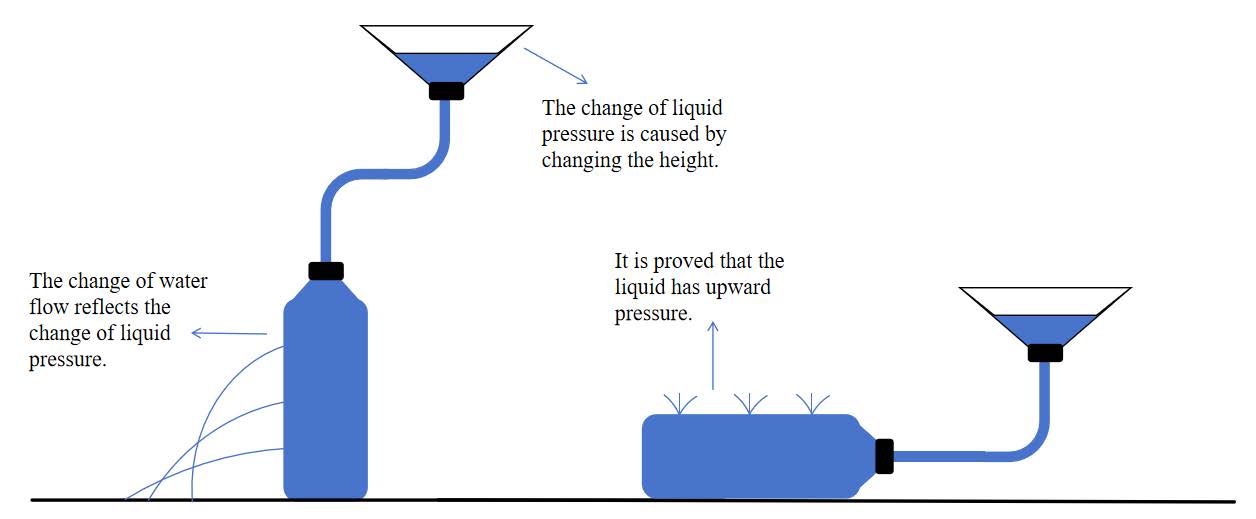
First, several small holes were carefully drilled at different heights along one side of a plastic bottle to serve as water outlets. The distance traveled by the water jets from these outlets provides a visual indication of the pressure at each depth, constituting a core function of the teaching aid. The holes should be small enough to produce coherent jets but large enough to prevent clogging. Typically, holes with a diameter of 1-2 mm are suitable.
Next, a second plastic bottle was modified by retaining its neck and cutting the body to form a simple funnel, facilitating easy pouring of water during experiments. The funnel should be wide enough to allow easy filling but narrow enough to fit securely into the tubing.
Then, holes were drilled into the caps of both bottles, matching the inner diameter of the plastic hose to ensure a secure fit. The connections between the hose and the caps were sealed using hot melt adhesive to ensure the airtightness of the system—a critical factor for maintaining experimental accuracy. Any leakage could compromise the results, so careful sealing is essential.
The completed teaching aid is not only low-cost, safe, and environmentally friendly but also effectively simulates the core principles of Pascal's experiment. Using this apparatus, instructors can conduct engaging experimental demonstrations, guiding students to manually operate the equipment, observe how the water jet distance varies with the height of the outlet, and thereby gain a deep understanding of the relationship between liquid pressure and liquid depth.
To further enrich the experimental scope, additional holes can be drilled at various heights and in different directions on the plastic bottle. This modification allows for exploration of liquid pressure in multiple directions, thereby broadening the investigative range and enhancing students' scientific inquiry skills. For example, holes drilled on the side, bottom, and top of the bottle can demonstrate that liquid pressure is exerted equally in all directions at a given depth.
Results
Experimental Use of Self-Made Teaching Aids
During operation, the teaching aid is filled with water, and the perforated plastic bottle is placed on a horizontal
surface. The funnel end is held at an elevated position. When the height of the funnel is held constant, students can
observe that the water jets emerging from the outlets increase in range from the top to the bottom holes, while the
flow rate remains consistent across all outlets. This visually demonstrates that pressure increases with depth.
When the funnel is gradually raised, the intensity and range of the water jets increase proportionally at all outlets, while the vertical gradient in jet distance persists. This shows that pressure at any point depends on the height of the liquid column above it. Conversely, when the funnel is lowered, the flow velocity and range decrease, yet the inverse relationship between depth and jet distance remains clearly observable. These operations successfully replicate the principle of Pascal's experiment in an educational setting. By applying the liquid pressure formula, students readily comprehend the proportional relationship between liquid pressure and depth. Through hands-on experimentation, they further discover that the range of the water jet is inversely proportional to the vertical distance from the outlet to the bottom of the bottle, and directly proportional to the vertical distance from the outlet to the free surface of the liquid in the funnel. Consequently, students accurately grasp the concept of "liquid depth" in liquid pressure—that it is the vertical distance from the point of measurement to the free liquid surface, and not the distance to the container bottom.
It is essential during demonstration to ensure that the transparent plastic hose is completely filled with water and that no air bubbles are present, so as to maintain scientific accuracy and avoid misconceptions. The combination of teacher demonstration and student hands-on operation significantly stimulates learning interest, leaves a lasting impression, deepens understanding of liquid depth, and fully embodies the "learning by doing" teaching philosophy.
After-School Practice with Self-Made Teaching Aids
Following classroom demonstrations, it is beneficial to capitalize on students' newly stimulated interest in physics
by extending learning beyond the classroom. Notably, during in-class activities, students primarily experiment with
pre-assembled teaching aids provided by the teacher and do not participate in the construction process. Therefore,
teachers can effectively substitute traditional written homework with practical after-school tasks. This not only
reduces the academic burden on students but also actively involves them in building their own teaching aids.
During the construction phase, students engage in deeper cognitive processing of abstract physical concepts. They encounter and resolve practical problems, which can later be discussed with the teacher. Under appropriate guidance, students experience a complete cycle of experimental inquiry, markedly improving their practical and investigative skills.
To further enhance hands-on ability, after completing the lesson on liquid pressure, students were assigned the task of constructing their own teaching aids as an after-school project. They were encouraged to either replicate the classroom model or innovate upon it, using their creation to verify the correct selection of liquid depth. After building the aid, students were guided to explore methods for demonstrating that liquids exert pressure in all directions, including upward. This activity compensates for the textbook's limited treatment of upward pressure, enabling students to move beyond merely imagining a "fountain" effect described by the teacher to actually observing and understanding upward liquid pressure through direct experimentation. To demonstrate this phenomenon, the lower bottle—originally positioned vertically—is simply placed horizontally. Students can then clearly see liquid being ejected upward from the holes, confirming that liquids indeed exert pressure in all directions.
This simple yet effective operation greatly enriches students' experimental experience and fosters a genuine spirit of scientific inquiry. Many students reported that the activity made physics more interesting and understandable, and some even proposed their own modifications to improve the design.
Discussion
The integration of self-made teaching aids into liquid pressure instruction effectively resolves students' confusion regarding the selection of liquid depth. Intuitive experimental phenomena significantly deepen conceptual understanding of this abstract topic and reinforce learning. Owing to their practical, intuitive, and scientific nature, self-made teaching aids ensure that every student can actively participate in experimental inquiry, thereby improving scientific skills and deepening comprehension of key physical quantities such as liquid depth. Moreover, the use of these aids in the classroom markedly stimulates learning enthusiasm and injects dynamic energy into the learning environment.
During after-school practice, students often generate new questions and ideas while replicating or modifying the teaching aids, leading to further improvements and innovations. This process vigorously activates innovative thinking. For instance, while reproducing the experiment, attentive students observed that when the liquid levels in the two bottles were equal, water ceased to flow, leading them to recognize the apparatus as a form of communicator. Teachers can skillfully incorporate this observation into the inquiry process, thereby not only resolving misconceptions about liquid depth but also introducing the principles of communicators. This cultivates students' ability to apply theoretical knowledge to practical problem-solving and deepens their understanding of both liquid pressure and communicators.
The study also highlights the importance of teacher guidance in the process of self-made teaching aid construction and use. While students are encouraged to explore independently, teacher support is crucial for addressing misconceptions, providing technical assistance, and facilitating deeper reflection. The role of the teacher evolves from knowledge transmitter to learning facilitator, which is more aligned with modern educational philosophies.
Furthermore, the use of self-made teaching aids supports the development of a range of generic skills, including teamwork, communication, problem-solving, and creativity. These skills are increasingly valued in the 21st-century workforce and are central to holistic education.
Conclusion
Through the innovative design and experimental application of self-made teaching aids, this study underscores the vital importance of hands-on operation in physics education. It not only facilitates a deeper understanding of physical concepts but also nurtures innovative thinking and problem-solving skills. The approach offers fresh perspectives and effective methods for teaching liquid pressure, contributing meaningfully to the advancement of quality physics education.
The self-made teaching aid described herein is low-cost, easy to produce, and highly effective in demonstrating the relationship between liquid pressure and depth. It engages students in active learning, promotes scientific inquiry, and aligns with curriculum standards and educational policies. Future work could explore the application of similar aids in other areas of physics education, as well as the long-term impact of such hands-on activities on student achievement and attitude.
Declarations
Author contributions
YY S: Conceptualization, Methodology, Formal analysis, Inves-tigation, Data curation, Writing – original draft, Writing – review & editing, Visualization.
Acknowledgements
Not Applicable
Funding information
Not Applicable.
Ethics approval and consent to participate
Not Applicable.
Competing Interests
Not Applicable.
Data availability
Not Applicable.
References
 Figures
 References
 Peer
Peer Information
Peer-review Terminology
Identity transparency: Single anonymized
Reviewer interacts with: Editor
Details
This is an open access article under the terms of the Creative Commons Attribution License(http://creativecommons.org/licenses/by/4.0/), which permits use, distribution and reproduction in any medium, provided the original work is properly cited.
Publication History
Received 2025-05-09
Accepted 2025-07-29
Published 2025-08-31