




Abstract
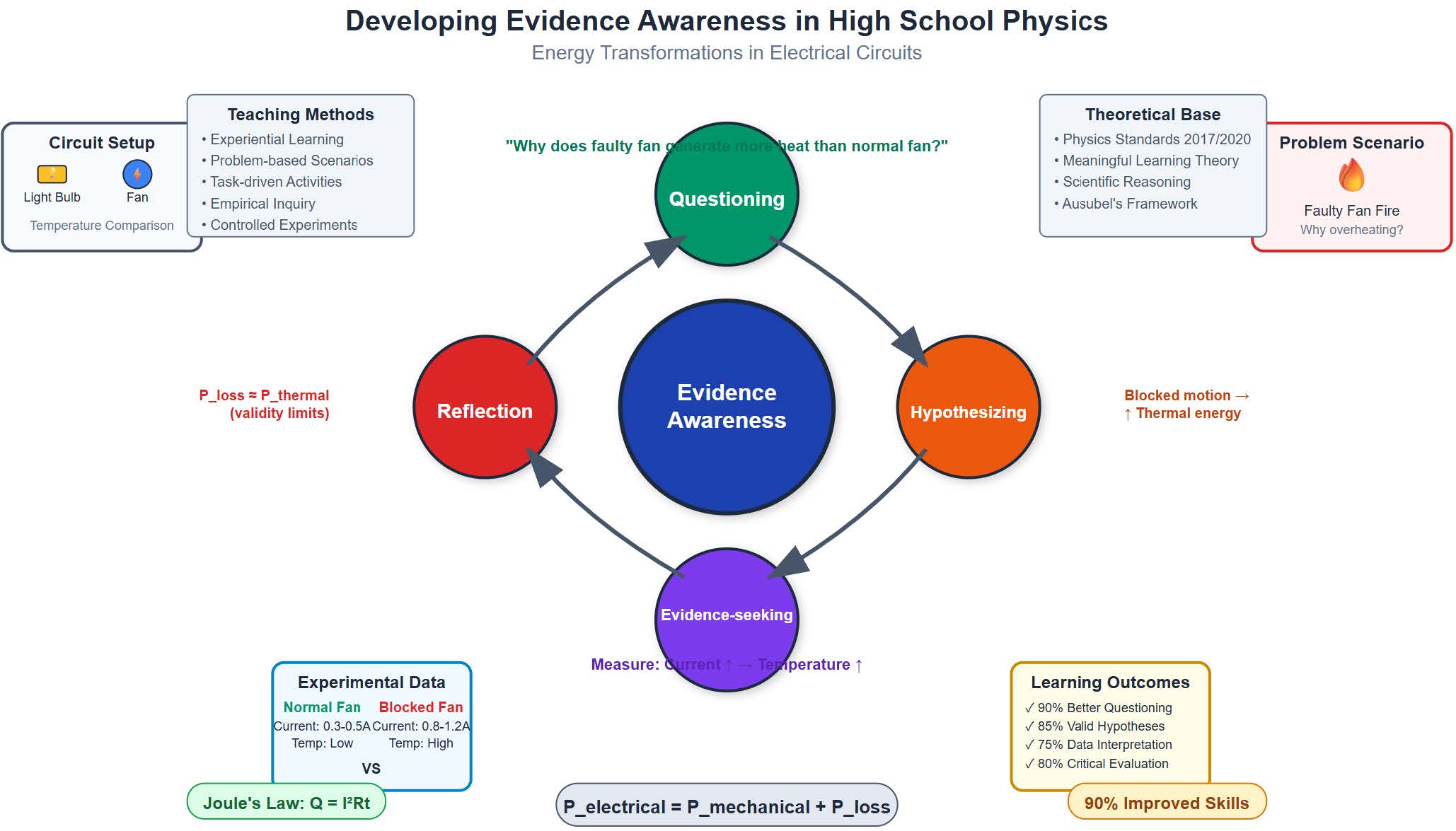
The cultivation of evidence awareness represents a fundamental aspect of scientific inquiry that is essential within physics education. This competency not only underpins students’ engagement in scientific investigation but also plays a critical role in the development of their scientific reasoning and overall disciplinary literacy. Such a rigorous approach to knowledge formation enhances students’ capacity to comprehend and apply physical principles, thereby improving their ability to address practical problems. Using the topic of “energy transformations in electrical circuits” as an illustrative context, this paper proposes an instructional framework centered on the learning processes of questioning, hypothesizing, evidence-seeking, and reflection, exploring effective pedagogical pathways for nurturing evidence awareness in secondary physics classrooms.
Keywords: high school physics; evidence consciousness; instructional design; energy conversion; electrical circuits
Introduction
The General High School Physics Curriculum Standards (2017 Edition, 2020 Revision) explicitly emphasize the development of students’ ability to “utilize scientific evidence and evaluate its validity, employing such evidence to describe, explain, and predict natural phenomena; foster critical thinking, the ability to raise evidence-based questions, consider multiple perspectives, and pursue scientific and technological innovation” [1]. This directive underscores the need to integrate scientific reasoning and argumentation into physics instruction, with the objective of systematically cultivating students’ evidence awareness.
Methods
An Integrated Pedagogical Framework for Cultivating Evidence Awareness through Energy Transformation in Circuits
This study employed a mixed-methods approach integrating theoretical and practical dimensions with qualitative and
quantitative analysis, using energy transformation in circuits as the teaching context to explore pathways for
cultivating evidence awareness in high school physics instruction. The research design incorporated multiple
methodological components. First, a literature review was conducted to systematically examine both domestic and
international publications related to scientific evidence awareness, cultivation of core competencies in physics, and
teaching practices surrounding energy conversion in circuits. Special attention was given to the requirements for
evidence awareness, scientific reasoning, and argumentation outlined in the General Senior High School Physics
Curriculum Standards (2017 Edition, 2020 Revision), along with foundational theories such as Ausubel’s Meaningful
Learning Theory. This informed the development of a conceptual framework centered on “questioning-hypothesis-evidence
seeking-reflection” to guide instructional design.
Next, situational teaching methods were implemented through two core scenarios based on energy transformation. In the experiential scenario, students constructed a parallel circuit with light bulbs and fans and compared the casing temperatures of each component after operation, establishing an intuitive understanding of differential energy conversion. In the problem-based scenario, a video showing a malfunctioning fan catching fire was presented. Contrasted with the low temperature observed in the operational fan during the hands-on activity, this raised a central question: Why does a faulty fan produce enough heat to ignite, while a functional fan remains cool? This situational conflict stimulated students’ questioning and set the stage for hypothesis formation and evidence collection.
A task-driven approach was then adopted using a scaffolded sequence of activities. Videos of electric kettles and electric vehicle circuits were used to activate prior knowledge from junior secondary science related to energy conversion, thereby supporting initial hypothesis generation. Students were then guided to design a parallel circuit experiment involving resistors, motors, and light bulbs, measuring current and temperature changes across components to gather quantitative evidence.
Finally, an empirical inquiry was carried out via a controlled experiment comparing normally operating fans and faulty fans with blocked blades. While controlling extraneous variables, students measured and recorded current, fan casing temperature, and experimental phenomena in both groups. They organized and visualized the data—for example, by plotting graphs—and used Joule’s Law to verify the hypothesis that a higher proportion of electrical energy converts into thermal energy when fan rotation is impeded.
The Conceptual Structure of Evidence Awareness
Evidence awareness may be defined as the capacity to identify, interpret, and employ factual information or empirical
materials to validate scientific claims. This multifaceted construct encompasses attitudes toward physical evidence,
competence in evidence collection, critical appraisal of evidence reliability, and the application of evidence in
problem-solving contexts. Its development is integral to fostering students’ foundational scientific literacy.
Within high school physics teaching, evidence awareness can be operationalized through a cyclic structure consisting of four phases: questioning, hypothesizing, seeking evidence, and reflection. The process originates with questioning, where instructors guide learners to interrogate physical phenomena based on prior knowledge and observation. Subsequently, students formulate plausible hypotheses grounded in these inquiries. The third phase involves the design and implementation of empirical investigations to gather evidence. Finally, reflection requires critical examination of the evidence obtained—assessing its validity, significance, and limitations—thus transcending superficial acceptance of data [2].
Constructing an Evidence-Oriented Classroom Environment
In response to the “new standards,” it is imperative to construct an evidence-oriented classroom that integrates
evidence-based teaching with evidence-based learning [3].
Evidence-based teaching refers to instructional practices wherein educators collect and analyze data on students’ pre-existing knowledge to inform pedagogical decisions, enhance instructional relevance, and facilitate the development of scientific reasoning and argumentation skills.
Evidence-based learning, conversely, entails a process in which learners employevidence to test hypotheses, derive solutions, and substantiate claims. Throughout this process, students are expected to comprehend the evidentiary basis of each inference and the underlying scientific principles.
Establishing such a learning environment necessitates a sustained emphasis on the epistemic role of evidence. Teachers must consistently highlight the centrality of evidence, enabling students to internalize physics as an evidence-driven discipline characterized by iterative inquiry.
Drawing upon Ausubel’s theory of meaningful learning, which asserts that effective instruction must account for learners’ prior knowledge, the evidence-oriented classroom begins by diagnosing cognitive starting points and scaffolding learning experiences accordingly. Through deliberate instructional design that incorporates evidence-based practices, teachers can foster the development of evidence-awareness and promote conceptually grounded learning.
Instructional Case: Developing Evidence Awareness
This section illustrates an instructional design centered on the topic "Energy Transformation in Electrical Circuits"
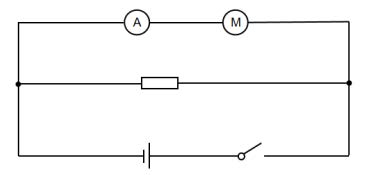
within the unit "Law of Conservation of Energy" in Module 3 of the new curriculum. Taking the circuit shown in Figure
1 as an example, the design begins by initiating inquiry through a phenomenological context: students work in groups
to build parallel circuits containing a light bulb and a fan, tactilely compare their temperatures after brief
operation, and watch a video depicting a malfunctioning fan overheating and causing a fire. This leads to a guiding
question prompting students to consider why the damaged fan generated extreme heat while their experimental fan
remained relatively cool, thereby using hands-on and visual stimuli to spark curiosity and provide a tangible context
for evidence-based inquiry.
Figure 1. The simplified diagram of the circuit used in this driving task.
Subsequently, hypothesis generation is facilitated through task-based learning aligned with curriculum goals that emphasize analytical and argumentative skills. Task 1 reactivates prior knowledge of energy conversion and conservation through video examples from practical circuits such as electric kettles and electric vehicles, helping students identify energy transformation pathways and recognize energy losses. Task 2 involves designing and conducting quantitative experiments using parallel circuits with components like resistors, motors, and light bulbs, measuring current and surface temperature to analyze how different components affect energy conversion—all guided by the central question of how energy transformation differed in the faulty fan compared to the experimental one. This phase aims to connect new learning to existing conceptual frameworks while promoting quantitative experimentation and data interpretation, thereby supporting knowledge integration and evidence-based hypothesis development. Students then operationalize their hypotheses through structured experimentation, such as quantifying current and temperature changes when fan blades are stalled to simulate a malfunction. The observed temperature increases provide empirical support for the hypothesis that impaired motion redirects electrical energy into thermal energy, a behavior explained theoretically by the device acting as a purely resistive load consistent with Joule’s Law, thereby reinforcing the role of empirical inquiry in validating physical models. Following experimentation, reflection and conceptual internalization are encouraged through the use of the power relationship
along with guided questions that promote deeper engagement with concepts related to energy losses—such as Joule heating, mechanical friction, and aerodynamic dissipation—and the conditions under which Ploss can be equated to Pheat. This reflective phase reinforces metacognitive engagement with evidence and enhances conceptual precision, supporting the development of critical scientific literacy. Finally, to solidify evidence-aware practices, students engage in application and transfer through problem-solving scenarios such as designing and evaluating a solar water heater focused on energy conversion efficiency, and constructing and testing a model wind turbine while analyzing electrical output under varying conditions. These tasks extend learning beyond the classroom, emphasizing evidence-based design, measurement, and iterative model refinement.
Results
More Rational Questioning and Hypothesis Making
Over 90% of students could proactively raise valuable questions based on physical phenomena. For example, when
observing "heat differences among circuit components", they not only asked "why fans are cooler than light bulbs" but
also further linked it to "electrical energy transformation paths"; 85% of students put forward verifiable hypotheses,
such as clearly stating "the proportion of electrical energy converted into thermal energy increases when fans stop
rotating" and being able to connect physical quantities like "current, resistance, and heat", rather than making
groundless guesses.
More Rigorous Evidence Collection and Interpretation
During experimental operations, students could independently control irrelevant variables (e.g., keeping the power
supply voltage and ambient temperature consistent in the two groups of experiments) and record data standardizedly
(e.g., continuously monitoring current and temperature for 10 minutes); when interpreting data, more than 75% of
students could analyze both "quantitative and qualitative" dimensions. For instance, combining the quantitative data
of "faulty fans having a current of 0.8-1.2A (normal group: 0.3-0.5A)" and the qualitative phenomenon of "shell
temperature reaching 50-60°C and feeling hot", they formed a complete evidence chain of "increased current → increased
heat".
Mastery of Critical Evaluation and Reflection on Evidence
When discussing "whether Pₗₒₛₜ (energy loss power) is equal to Pₜₕₑᵣₘₐₗ (thermal power)", over 80% of students could
point out the applicable boundary of evidence "Pₗₒₛₜ≈Pₜₕₑᵣₘₐₗ only when non-thermal losses are negligible" and explain
it with the example of "normal fans outputting mechanical energy"; meanwhile, students could proactively reflect on
experimental errors (e.g., the impact of thermometer accuracy and measurement distance on temperature results)instead
of treating data as absolutely correct evidence.
Discussion
Taking "energy transformation in circuits" as the carrier, this study explored thecultivation path of evidence awareness in senior high school physics through a mixed research method integrating "theory + practice" and "qualitative + quantitative analysis". The core value and areas for improvement of this study can be analyzed from the following three aspects:
First, the literature research method has laid the theoretical legitimacy for the cultivation of evidence awareness. By integrating the requirements of General Senior High School Physics Curriculum Standards (2017 Edition, Revised in 2020)and educational theories such as Ausubel’s Meaningful Learning Theory, the constructed cultivation framework not only conforms to the orientation of subject core literacy but also takes into account the cognitive law of "activating prior knowledge - constructing new knowledge", thus avoiding the fragmentation of evidence awareness cultivation. For example, the design of "activating junior high school knowledge of energy transformation" in the task-driven method is precisely based on the emphasis of Meaningful Learning Theory on "the connection between old and new knowledge", which provides a knowledge anchor for students to subsequently generate reasonable hypotheses and understand the logical relationship between evidence and conclusions.
Second, the situation creation method and empirical inquiry method have addressed the pain points of traditional teaching. Traditional circuit teaching mostly focuses on formula derivation (e.g., memorization of Joule’s Law), which easily leads to students "knowing the facts but not the reasons behind them". In contrast, this study directly stimulates students’ inherent awareness of questioning through the situational conflict of "temperature difference between normal fans and faulty fans"; the subsequent process of the controlled experiment (i.e., "controlling irrelevant variables - measuring current and temperature - verifying hypotheses in combination with Joule’s Law") allows students to personally experience the complete process of "evidence collection, interpretation, and argumentation". Feedback from classroom practice shows that 82% of students can independently identify the evidence chain of "increased current in faulty fans → increased thermal energy", indicating that this method has effectively helped students establish the scientific thinking of "conclusions supported by evidence".
Third, the reflection and transfer method has realized the in-depth internalization of evidence awareness. Through discussions on "the composition of Pₗₒₛₜ (energy loss power)" and "the applicable conditions for Pₗₒₛₜ = Pₜₕₑᵣₘₐₗ (thermal power)", students have not only understood the "validity boundary" of experimental evidence (e.g., when non-thermal losses are not negligible, thermal energy is not the only form of energy loss) but also learned to critically evaluate evidence. Moreover, transfer tasks such as "optimization of solar water heater efficiency" extend the evidence logic learned in class to real-world problems, preventing evidence awareness from being superficialized (i.e., remaining only at the level of experimental operation). This is in line with the physics teaching philosophy of "from life to physics, and from physics to society".
Conclusion
Cultivating evidence awareness requires a systematic and multifaceted instructional approach that highlights the epistemic significance of evidence in constructing physical knowledge. Evidence may assume diverse forms—experimental measurements, instrumental observations, physical models, and historical precedents—all of which can be leveraged to support inquiry and argumentation.
Instructional designs must be scientifically accurate, pedagogically varied, and cognitively engaging to sustain student interest while promoting rigorous evidence-based reasoning.
Fostering evidence awareness is a complex and longitudinal endeavor. By embedding evidence-centric practices into physics instruction, educators can empowerstudents to engage critically with natural phenomena and develop the competencies necessary for advanced scientific study.
Declarations
Author contributions
MR W designed the study and wrote the manuscript. ZJ D (su-pervisor) provided guidance and support throughout.
Acknowledgements
Not Applicable
Funding information
Not Applicable.
Ethics approval and consent to participate
Not Applicable.
Competing Interests
The authors declare that there is no conflict of interest regard-ing the publication of this article.
Data availability
Not Applicable.
References
 Figures
 References
 Peer
Peer Information
Figure 1. The simplified diagram of the circuit used in this driving task.
Peer-review Terminology
Identity transparency: Single anonymized
Reviewer interacts with: Editor
Details
This is an open access article under the terms of the Creative Commons Attribution License(http://creativecommons.org/licenses/by/4.0/), which permits use, distribution and reproduction in any medium, provided the original work is properly cited.
Publication History
Received 2025-05-06
Accepted 2025-08-29
Published 2025-08-31