




Abstract
Objective:Deep learning is essentially a machine learning method based on neural network. The introduction of the deep learning concept in physics teaching can help students better understand physical principles and cultivate students' core literacy, which is in line with the requirements put forward in the new curriculum standard.
Methods:This paper puts forward a teaching strategy of how to guide students to ask questions and promote students' deep learning in high school physics teaching.
Results:By guiding students to ask questions, teachers can improve students' ability of deep learning, so as to effectively cultivate students' core physical literacy. At the same time, it also provides a reference for teachers to guide students and apply deep learning theory to high school physics.
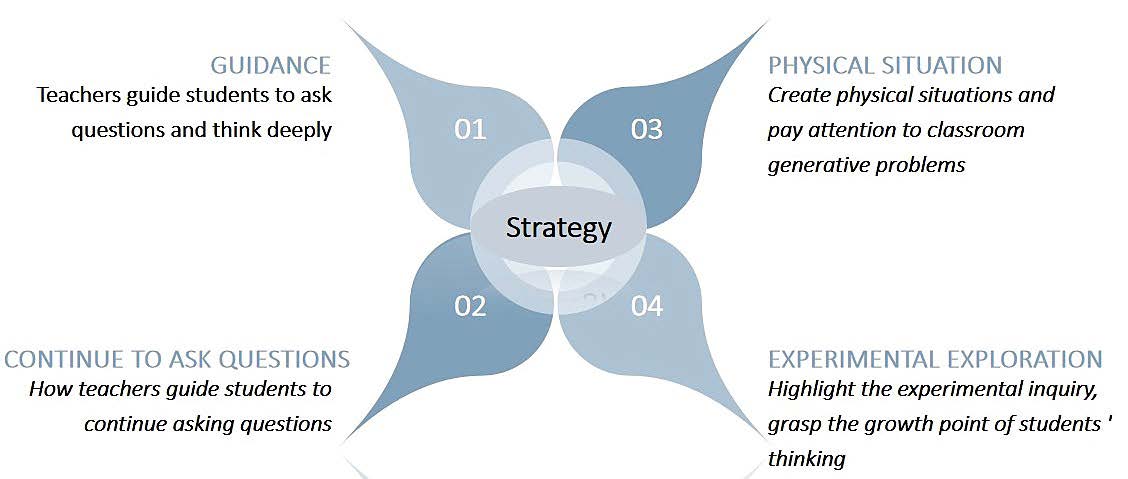
Conclusions:By creating physical situations, paying attention to classroom generative problems, highlighting experimental exploration and grasping the growth point of students' thinking, students are guided to put forward in-depth and enlightening questions, so as to promote the in-depth development of students' thinking and the understanding and mastery of subject knowledge.
Keywords: physics teaching; deep learning; teaching strategies; student questioning
Introduction
With the rapid development of the information age, the field of education has also ushered in unprecedented changes. The "General High School Physics Curriculum Standards (2017 Edition 2020 Revision)" proposes the concept of subject core literacy, including physical concepts, scientific thinking, scientific inquiry, and scientific attitudes and responsibilities [1]. Among them, scientific thinking and scientific inquiry put forward new requirements for students' ability to question innovation and put forward physical problems. As a research hotspot in the field of education in recent years, deep learning is constantly changing the development and application of various fields. The concept of deep learning is also gradually introduced into physics education. The purpose is to realize the internalization of knowledge and the improvement of ability by guiding students to explore and think actively [2]. In this context, it is of great significance to explore the strategies of how to ask questions in high school physics teaching for deep learning, which is of great significance for continuously improving teaching quality, promoting students' all-round development and deepening education reform.
Bloom divides the cognitive field into six levels: memorization, understanding, application, analysis, synthesis, and evaluation. The goal of deep learning is to cultivate higher-order thinking, which corresponds to three higher-order levels: analysis, synthesis and evaluation [3]. Deep learning emphasizes that students acquire knowledge by deepening their understanding, and flexibly use knowledge to ask questions and solve problems; deep learning focuses on the process of students' acquisition of knowledge rather than the results. Students' questioning is a process of students' thinking and internalization of knowledge. The theory of cognitive flexibility proposed by Spiro also emphasizes the flexible transfer of knowledge through deepening understanding. Only by forming a deep understanding of knowledge can students use knowledge flexibly to solve problems. The theoretical basis of deep learning can be traced back to the field of psychology, which is consistent with the views of the above two cognitive fields [2].Students' questioning is a key link in the process of deep learning of high school physics, which plays an important role in stimulating students' thinking, deepening knowledge understanding and improving learning effect. However, in real life, most students lack the awareness and skills of asking questions, and even avoid asking questions, which leads to a passive and ineffective learning and thinking process. Even if students can ask questions, due to the lack of knowledge level, lack of logical resolution, vulnerability to external interference and other factors, the quality of questions is not high, and the expected effect of deepening thinking cannot be achieved. Therefore, it is very important for teachers to guide and train students to master effective questioning strategies and methods.
Through in-depth analysis of high school physics students' questioning strategies for deep learning, this paper explores how to effectively guide students to ask questions and how to cultivate methods and means to improve students' questioning ability, so as to provide theoretical support and practical guidance for high school physics deep learning. At the same time, this paper also hopes to provide useful reference and inspiration for the deep learning of other disciplines through the study of students' questioning strategies.
Methods
The importance of students' questioning for deep learning
In the process of teaching, students' questioning often plays an extremely important role. It is like a magic key to
open the door of a deeper knowledge treasure house, which is of great significance to the whole teaching process. In
traditional middle school physics teaching, teachers often give priority to teaching, and students are in a state of
relatively passive acceptance of knowledge. However, with the continuous updating of educational concepts, more and
more emphasis is placed on the dominant position of students and the importance of active learning [4]. Students'
questioning is an important behavior of their active learning and active exploration. It has irreplaceable value in
the process of physics teaching in middle schools and is worthy of in-depth study and discussion.
In the process of learning, students who think actively are more active than those who do not think actively. Students' questioning is an important way of active thinking, which is conducive to thinking about the problems encountered from many aspects or to a deeper level; students' questions are also an important bridge to establish communication between teachers and students. From students' questions, it is easier for teachers to understand students' difficulties and confusion. If teachers only ask questions in the process of teacher-student communication, students are in a state of passive acceptance of information, and it is difficult to form a series of forms to promote deep learning, such as active thinking, asking questions, solving problems, and evaluating the effectiveness of answers. Therefore, the importance of students' questions for deep learning is self-evident.
The problem is the starting point of deep learning. With the help of students' physical problems with group inquiry value, students are widely involved in problem solving, and students' deep learning can be realized. The deep learning caused by students' questions is mainly reflected in the following aspects.
Students can understand learning critically
When students ask questions, in fact, it is not only to seek answers to the questions, but also to think deeply and
criticize the knowledge they have learned. Critical understanding requires students to have a more comprehensive grasp
of the knowledge they have learned and to be able to analyze the knowledge at multiple levels. By asking questions,
students can take the initiative to find loopholes and deficiencies in their own knowledge system and form a more
comprehensive and accurate understanding.
Students can transfer and apply knowledge
If students think seriously and put forward meaningful questions, this process is to apply the knowledge they have
learned or transfer it to a new situation. If students often ask questions and master this ability, they can help
students consolidate what they have learned, cultivate innovative thinking, and improve their ability to ask questions
and solve problems. Then students can gradually master knowledge transformation to solve practical problems through
spontaneous questioning and deep thinking.
Students' problem-solving has made a breakthrough
When students ask questions, it shows that students are interested in or confused about the problems they encounter at
present. In the process of students' solution, they may also encounter more confusion, but through the continuous
refinement and deepening of the problems or under the guidance of teachers, they may find ways or methods to solve the
problems. The breakthrough of solving the problem step by step can fully stimulate students' learning enthusiasm and
self-confidence, bring satisfaction and sense of achievement to students, and further promote students' ability to
think deeply and ask questions.
Results
Teachers guide students to ask questions and think deeply
In the process of high school physics learning, students' questioning and deep thinking are of great help to students'
own improvement. However, many students still lack some questioning skills and deep-thinking ability. As the guide of
students' learning, teachers' guidance is very important. We can help teachers guide students to ask questions and
think deeply in teaching from the following aspects.
The first is to create an atmosphere of questioning. Teachers should create an equal and inclusive classroom environment, which can allow students to express their views, so that students dare to ask questions, and even if students ask questions and ask questions are not satisfactory, they should also give students steps, so that students will not be embarrassed that students will avoid asking questions [5]. Encourage students to ask questions boldly, do not be afraid to make mistakes, or be laughed at. For students to ask even simple or seemingly naive questions, teachers should give patient answers and positive affirmation, so that students feel that questions are welcome, and the classroom is a place where they can freely express their doubts. For example, teachers can often say ' students, what do not understand the place to ask at any time, there is no so-called silly question, as long as you think are good questions', through such words to create a relaxed atmosphere, enhance the courage of students to ask questions.
The second is that teachers can tell and share their own questioning experience to stimulate students' awareness of questioning and enhance students' motivation to ask questions. In terms of questioning skills, teachers can also teach students some questioning skills, carry out heuristic teaching, split a question into multiple small questions, and guide students to ask questions step by step in the form of question strings. After students ask controversial questions, students should be allowed to conduct critical analysis from multiple perspectives [6].
The third is to stimulate students' deep thinking. Teachers can inspire students to discover and think about problems by setting suspense, displaying interesting physical experiments, or life phenomena. For example, in the process of introducing situations, more examples of life or experimental phenomena are combined to guide students to think deeply about the physical principles. Or design some exploratory physics experiments, so that students can ask questions and solve problems in practice, to stimulate their deep thinking. Or try to integrate with other disciplines, carry out interdisciplinary practice, broaden students' horizons, and help students think interdisciplinary.
The role of teachers in high school physics learning is not only the imparter of knowledge, but also the guide of students' learning. By guiding students to ask questions and think deeply, teachers can help students build a solid knowledge base and help students conduct physical deep learning.
How teachers guide students to continue asking questions
After students ask questions, they want students to learn and think deeply. Follow-up questioning is an indispensable
part that requires teachers to make corresponding strategies to guide students to continue asking questions. First of
all, we must affirm and encourage students' original problems, so that students feel recognized. Then, through the
form of rhetorical questions or follow-up questions, we can guide students to think deeply about the original
problems, identify the key words in the problems, think about the correlation between them, and think about the
problems from a broader perspective. In this way, it is possible to put forward physical problems related to the
original physical problems and more in-depth and broader physical problems.
Whether in class or after class, students can be divided into groups to discuss the initial problems, brainstorm, and try to put forward new problems. Teachers, as instructors, provide necessary help. For each student's question, teachers should give feedback to point out the advantages and disadvantages, and give suggestions to facilitate students' standardization and thinking of subsequent questions. Teachers maintain a patient attitude, do not need to rush to give answers or solutions, encourage students to try a variety of methods to think from multiple angles, and respect students' ideas. Finally, teachers should demonstrate how to ask questions from different levels, and can also invite students to share their experiences and strategies to set an example for other students.
Create physical situations and pay attention to classroom generative problems
In the process of high school physics teaching, teachers should try their best to create real physical situations,
guide students to use the formed physical concepts and scientific thinking to ask questions and solve problems in
life. In the situation, students will naturally have problems, so as to stimulate students' ability to put forward
generative problems. When creating a physical situation, we should pay attention to the authenticity and interest of
the situation, to arouse students' interest and curiosity; the situation should be related to students' daily life and
practical experience, so as to facilitate students' understanding and acceptance; the situation should also have
certain complexity and challenge, which can stimulate students' desire to explore and vitality of thinking.
The problem of classroom generation is the problem that students put forward according to the content they have learned and their own understanding in the process of classroom teaching. These problems often represent obstacles that students encounter during their learning process, directly reflecting their genuine confusion—a valuable resource for promoting deep learning. As teachers, we need to pay attention to the generation of these problems, accurately grasp the difficulties of students, and provide targeted guidance. Generative problems can promote students' autonomous learning and critical thinking while enhancing their problem-solving abilities and innovative mindset. Teachers should focus on creating authentic learning contexts, guide students in formulating generative problems, and ultimately achieve deep learning goals in high school physics education.
For example, when teachers teach the knowledge of Newton's third law, in order to let students intuitively feel the relationship between Newton's third law-force and reaction force, a tug-of-war competition can be organized as a teaching situation, divided into two teams and multiple groups to compete, and guide students to observe and feel the tension at both ends of the rope during the competition. In this process, students can not only experience the role of force, but also intuitively see the existence of force and reaction force. In this situation, students may ask questions: Why can both teams feel the pull of the rope? What is the relationship between these two tensions? Then, after the questions generated in these classes, teachers can also guide students to think further: What determines the outcome of the tug-of-war? In addition to the size of the two teams, will there be other factors affecting the results of the game? Through the thinking and exploration of these problems, students can deeply understand Newton's third law-the force and the reaction force are always equal in size, opposite in direction and acting on the same line, and can take the initiative to think and explore the application of mechanical principles in real life.
Highlight the experimental inquiry, and grasp the growth point of students' thinking
Physics is a natural science based on experiment, and experiment is its essential attribute. Therefore, it is
necessary to pay attention to experimental inquiry in high school physics teaching, which is an important way to
cultivate students' deep learning and thinking development. Teachers should make full use of practical inquiry to
guide students to find physical problems and improve their ability to put forward in-depth problems. The growth of
students' thinking refers to the active development of thinking in the process of learning and experimentation, which
can easily produce innovative ideas and put forward deep problems. Therefore, we need to seize the students' thinking
growth point, encourage and guide them in the exploration of constantly tap the potential. This not only helps to
improve their learning efficiency and interest, but also cultivates their critical thinking and creative ability to
solve problems. This kind of thinking and quality is necessary for students to carry out deep learning.
For example, in the inquiry experiment of free fall, the design of the experiment is that students use a timer and a paper bag to release objects from different heights, and observe the dots left by the timer on the paper tape for data processing and analysis. In the process of this experiment, as a teacher, you can think about how to grasp the growth point of students' thinking, guide students to ask questions about why objects from different heights, and the distance between the dots left on the paper tape will gradually increase. The emergence and thinking of this problem obviously means that the speed of the object in the process of falling is increasing. Based on this problem, the students are guided to carry out the hypothesis and prediction of the experiment. If the air resistance is ignored, the acceleration of all objects in the same place should be the same (equal to the acceleration of gravity g). Then the experimental verification is carried out, and the distance between the measured points is used to calculate the acceleration to verify the hypothesis. Finally, students are allowed to discuss and reflect freely, to explore the influence of air resistance on the experimental results, and how to further verify the law of free fall motion by improving the experimental conditions (such as using a vacuum tube).
The growth point of students' thinking is particularly important in the learning process. When students encounter contradictions with the original cognition in the learning process, cognitive conflicts may occur, which can trigger their thinking. Teachers should pay attention to these cognitive conflict points, grasp the students' thinking growth points, guide them to put forward problems with a certain depth, and solve these problems through discussion, experiment, and so on. Through experimental exploration, it can not only stimulate students' interest and enthusiasm in physics but also help them establish a solid foundation of physics, promote their thinking development, and achieve the goal of deep learning in high school physics.
Discussion
Sources of students' questions
Students' questions will be affected by many aspects. First of all, from the individual situation of students, this is
related to students' personal curiosity, curiosity, learning motivation, learning background and learning experience.
Some students have a strong interest in physics and will take the initiative to explore some in-depth physical
phenomena, thus generating doubts and asking questions. Students' curiosity will also drive them to explore some
seemingly simple but actually esoteric physical problems or phenomena, so as to ask questions. However, the background
and experience of learning will affect the content or the way of asking questions. For example, excellent students may
ask more in-depth and specific questions, while students with learning difficulties may ask relatively more basic and
superficial questions. Students' learning motivation will also affect the frequency and quality of their questions.
For those students who are active in learning, they are more inclined to ask deep thinking and challenging questions
to promote their own learning progress.
In addition, in the course of the teacher's class, students encounter new knowledge, which naturally leads to new questions, or how the after-school exercises and homework are related to the reality of life. As a teacher, we should clarify the source of the problem, so as to better understand the students' learning situation and needs, so as to adjust the teaching methods and strategies, improve the teaching effect, and cultivate the students' ability to think deeply.
Are the questions raised good questions?
In the process of students' learning, many students can ask questions, but the questions raised are not all good
questions, which involves the quality and effectiveness of students' questions, and we need to analyze and discuss
them from multiple dimensions.
First of all, a good physical problem should have clear directivity and practicality. Good problems need to be closely related to the content knowledge of the subject, help students to understand the knowledge they have learned, promote the internalization and migration of knowledge, and guide students to practice and explore the physics subject. Through practical activities, we can deepen our understanding of the problem and improve our ability to solve the problem.
Secondly, a good physical problem should also be challenging and enlightening. It can trigger students to think, stimulate students' curiosity and thirst for knowledge, take the initiative to explore the answer instead of blindly waiting for the teacher's answer, encourage students to look at the problem from different angles, and cultivate students' critical thinking and innovation ability. And the problem has a certain degree of difficulty, which can enable students to grow and progress in the process of solving problems and stimulate learning motivation.
Some problems may not be deep, challenging, or enlightening, and cannot effectively promote the development of students' deep learning and thinking. For these problems, teachers should guide and answer according to the specific situation to help students clarify their thinking, correct mistakes, and deepen their understanding. Therefore, not all the questions raised by students are good, and teachers need to pay attention to the quality and effectiveness of the questions in the process of guiding students to ask questions.
Relationship between asking questions and solving problems
In the process of students' learning physics, when they encounter confusion or problems, there will be problems. After
the students can organize the language to ask questions, the next step will naturally face how to solve the problem.
Asking questions is the beginning of students' active thinking and exploration, and it is the source of motivation for
students to think deeply and learn. Solving problems is the process of students obtaining answers and solutions
through thinking, research and practice, which can promote the construction of students' knowledge. These two are the
key links of students' learning and growth.
There is a circular interaction between asking questions and solving problems. Students may encounter new challenges or questions in the process of solving problems, and these new problems will lead students to further think and learn. Asking questions and solving problems complement each other and jointly promote students' learning and development.
There are different views on which is more important in the relationship between asking questions and solving problems. In fact, we should look at this problem dialectically, because the two are born with each other between asking questions and solving problems. When asking questions, there is naturally a problem to solve the problem, and it is impossible to say who is more important, but asking questions is in front. How to put forward a good question is what we should pay more attention to; otherwise, the solution of the problem is meaningless; at the same time, after we have clarified the problems raised, how to solve the problem more perfectly is also what we should pay attention to, because a good process of solving the problem can often bring us greater improvement.
When guiding students to ask questions and solve problems, teachers should pay attention to balancing the relationship between the two, encourage students to ask good questions, and guide them to solve problems through thinking and practice, so as to promote the all-round development of students.
Conclusion
This paper primarily examines how teachers guide students to ask questions to facilitate deep learning in accordance with the core literacy requirements of physics. The deep learning theory is applied to the study of high school physics, and the importance of students' questions to deep learning is analyzed. The relationship between the source, quality, and problem-solving of students' questions. Then it gives the strategies of how teachers guide students to ask questions and think deeply, and how to guide students to ask questions further after students ask questions. In the process of physics teaching, we should create physical situations, pay attention to classroom generative problems, highlight experimental inquiry, and grasp the growth point of students' thinking.
Of course, in actual teaching, guiding students to ask questions to promote deep learning still faces many challenges, such as students' psychological concerns and teachers' distribution of teaching energy. Therefore, it is also necessary for educators to continuously explore and practice, and continuously improve teaching methods and strategies to better adapt to the requirements of physics teaching in middle schools in the new era, so that students' questions can shine more brightly in deep learning.
Declarations
Author contributions
Yang Zhao: Conceptualization, Methodology, Formal analysis, Investigation, Data curation, Writing – original draft; Salamat Umar: Writing – review & editing, Visualization.
Acknowledgements
Not Applicable
Funding information
Not Applicable.
Ethics approval and consent to participate
Not Applicable.
Competing Interests
Not Applicable.
Data availability
Not Applicable.
References
 Figures
 References
 Peer
Peer Information
Peer-review Terminology
Identity transparency: Single anonymized
Reviewer interacts with: Editor
Details
This is an open access article under the terms of the Creative Commons Attribution License(http://creativecommons.org/licenses/by/4.0/), which permits use, distribution and reproduction in any medium, provided the original work is properly cited.
Publication History
Received 2025-05-12
Accepted 2025-08-13
Published 2025-08-31